Sleep Better

Having trouble waking up feeling refreshed?  A good night’s sleep makes life a whole lot better!!  Since the arrival of our new bubba, unfortunately my sleep routine is not as good as it used to be and I find myself reaching for a second (and often third coffee) most days.

sleep 2

“If only I could get another hour sleep…..if only my hair looked this good every morning”

Whilst for the short term my sleep may remain disrupted, here are some tips to help improve your sleep routine – having a good sleep routine and sticking to good habits before bed can help you to get to sleep and stay asleep easier.

  •   Make your bedroom dark.  Consider using curtains with a thick backing, or installing blinds or shutters.  Light coming in from street lights, other houses and apartments can play havoc with your sleeping patterns.  Artificial light can mess with our Melatonin levels (the chemical that helps us sleep!) and confuse our biological clocks.
  •  Keep the temperature cool.  If you are too warm (or too cold) you may have trouble sleeping.  A slight drop in body temperature facilitates sleep.  Avoid excessive layers or using heating if it isn’t necessary.
  •  Eliminate electronic devices such as televisions and computers.   Avoid falling asleep with the television or radio on.  Get rid of devices with bright lights and alarm clocks with LED lighting.
  • In the hour before you go to bed, avoid overly stimulating activities – try and minimise television and computer use as this will stimulate your brain making you feel more awake.  Try quiet activities such as reading instead.  Try dimming the lighting in your house/apartment in the hour before bedtime, to reduce artificial light and to signify to your body that sleep time in near.
  • Avoid stressful activities before bed!! Just before bedtime is not the time to reply to emails, finish assignments or homework or engage in a discussion about finances!  Avoid discussing potentially stressful topics before bed as this is likely to leave you tossing and turning.  Keep stressful discussions for the morning when you’re at your full alert level and have the resources to engage in problem solving.
  •  Establish a “before sleep” routine.  By performing a routine before bed each night, your mind will begin to associate this routine with sleep.  For example, this might be having a cup of herbal tea, putting on your pyjamas, reading for 20 minutes, washing your face, brushing your teeth, dimming the lights etc.  Establish a “bed time” and waking time.  If you go to sleep at 10:30pm every night and wake up at 6:30am every morning, your body will become used to this sleep pattern.
  • Reduce caffeine from the afternoon.  Avoid coffee, black tea and cola after about 3pm as these stimulants may affect your ability to get to sleep at night.
  • Reflect on your alcohol use.  Excessive drinking can disrupt your sleep patterns.  Whilst alcohol can make you feel tired, it produces both stimulant and depressive effects.  If you’re drinking on a nightly basis, considering having alcohol free nights during the week.
  • Ensure you have exposure to natural light during the daytime.  Exposure to natural light during the day ceases the production of melatonin, a chemical produced by the body which facilitates sleep.  During the darkness, the body then produces melatonin which causes drowsiness and sleep.
  • Keep the bedroom for sleep and sex only.  Avoid other activities such as working in bed, doing homework in bed, watching tv, studying etc for other rooms.  Otherwise you may begin to associate bed with work/stress etc!!
  • Keep your bedroom clean and free of clutter and distractions.  Take the time to create a peaceful and serene environment that facilitates rest.  Try decordating with soft textiles, warm blankets, lots of cushions and scented candles!!

sleep

Do you have a pre-sleep ritual?  Would you try some of these tips?  Sweet dreams!!

Kimono and eye mask - Peter Alexander
Cushions - Country Road

narcissism

New study claims parents may contribute to narcissism in children

Everyone seems to be talking about a new study by Brummelman et al (2015), conducted in the Netherlands, which showed that children who are told that they are special and superior to other children are more likely to become narcissists.  In turn, parents of narcissistic children may over-value the abilities of their children and make claims about the children’s abilities that may not be true.

The study calls for parental training, to encourage parents to develop healthy self esteem in children through parental warmth and encouragement, rather than inflating the children’s egos!!  For example, children who are frequently told they are loved are more likely to have high self esteem, but not narcissism.

The researchers state:

“People with high self-esteem think they’re as good as others, whereas narcissists think they’re better than others”

Narcissism has it’s roots in genetics and temperamental traits, but this study shows that narcism may also be shaped by early socialisation experiences.

With this in mind, how do you foster healthy self esteem in your kids?  Here are a few of my suggestions!!!

  • Provide praise for specific accomplishments and achievements, such as working hard on a project or practising a skill
  • Reinforce task mastery rather than task outcome – for example, if your child practises tennis every week but loses his game on the weekend, reinforce the process of mastering the skill of the game through each practice session, more so than the outcome of the game
  • Reward your child for prosocial behaviour such as sharing or helping others
  • Model fairness through your own behaviour

What would you try?

LachyandJem

How to use your signature strengths

Are you looking for ways to boost your sense of well-being?

Research shows that people who are aware of their strengths and who regularly use and apply those strengths, have greater levels of well-being (Govindi & Linley, 2007).

Do you know what your signature strengths are?

Try the Values in Action questionnaire online for free, to find out what your top 5 strengths are!!  Once you identify your strengths, ask yourself the following questions:

How can I use one or more of my strengths on a daily basis?

How can I apply my strengths to one of my work tasks today?


Photo by RnR photographers

References

Govindi, R. & Linley, A (2007) Strengths use, self concordance and well-being:  Implications for Coaching and Coaching Psychologists.  International Coaching Psychology Review, 2(2), 143-154

Changing careers? Reflect on your values!

In my role I provide careers counselling on an almost daily basis.  A question many people ask is “what do I want to do with my life?”  To help answer this question, many people wish to learn more about their skills and strengths to help find out which jobs are the best “fit” for them.

I like to take a step back before I take a skills approach to look at possible job options, and start by thinking about what matters to the person – in other words, what do you value?  What matters to you in the grand scheme of things?

I often find that our skills help us to get a job, but it’s our values that will often determine if we stay in that job long term.  In order to stay in a job, our values need to be the right match to that job, otherwise we often lose motivation.

So what are your work values!?  Have you asked yourself this question before?

Some examples of common work values include things like the following:

  • I value opportunities to develop or progress in my career
  • I value work where I can be creative
  • I value work that allows me to maintain work/life balance, and won’t impact on my personal time
  • I value work that pays well
  • I value job security
  • I value helping others
  • I value the challenge of making a sale
  • I value working autonomously
  • I value working in a team

Have a think about your values, and how they fit in with your current or previous roles.  If you value job security, but work in a target based role, you may find yourself feeling stressed on a day to day basis!!  If you value creativity, but work in a heavily bureaucratic role, you may feel a lack of motivation.  If you place value on working autonomously, but are in a heavily micromanaged position, you may be unhappy.

In job interviews today, it’s common for employers to ask questions such as “how do your values fit in with the values of the company?” With this in mind, it’s important to know what your values are!!


what to do...

So ask yourself, what do you ultimately value in your work?  Is it money?  Career progression?  Freedom to live your life on the weekend?  Such questions will help you to narrow down your list of possible careers and employers.

Boost your psychological capital

What is psychological capital?  Psychological capital is made up of four unique characteristics – hope, optimism, resilience and self efficacy.  Studies should that people who score high in measures of Psychological Capital have better psychological wellbeing, as well as increased on the job performance (Avery, Reichard, Luthans and Mhatre, 2011).

So how can you increase your psychological capital to capitalise (excuse the pun!) your wellbeing?

Here are a few strategies you can try:

  • Set yourself small and challenging goals to increase your sense of self efficacy.  Try breaking down tasks into smaller components to make them less daunting.
  • Master a task!!  Task mastery increases self efficacy.  How can you do this?  Try observing someone such as a mentor or colleague and modelling the task based on their example.  Online tutorials such as You-Tube clips can be a great way to master a new skill if you don’t have a real life example.
  • Reflect on times you’ve overcome setbacks in the past to increase your resilience!  How did you do it?
  • Ask others to discuss how they might overcome a setback if they were in a similar position to increase your repertoire of strategies.
  • Think about how you can view a current challenging or difficult situation through a different perspective.  Are you working long hours at the moment?  What are some benefits of the situation?  Are you taking on more of a leadership role and expanding your skills?

Would you put any of these strategies to the test?


References

Avey, J.B., Reichard, R.J., Luthans, F. & Mhatre, K.H.  (2011).  Meta-analysis

of the impact of positive psychological capital on employee attitudes, behaviors, and performance, Human Resource Development Quarterly, 22(2), 127-152

Follow my blog with Bloglovin

Broaden and build with positive emotions

Positive emotions do more than make us feel good – they in fact help to increase our intellectual, social and physical resources!

The Broaden and Build Theory (Fredrikson, 2001) states that positive emotions such as joy, interest, contentment, pride and love increase our repertoire of thoughts and behaviours.  For example, the emotion of interest increases the urge to explore and take in new information, and the emotion of joy increases our urge to play and be creative.  The emotion of love increases our urge to savour and share experiences with our loved ones.

Negative emotions on the other hand, narrow our range of potential strategies for action – for example, the negative emotion of fear may lead us to simply flee or escape danger, which serves for the purpose of survival. However, when imminent danger is not present, negative emotions may narrow our range of cognitive resources when we need them the most.  For example, you’re about to give an important presentation at work and are feeling terrified – the emotion of fear may lead us to focus narrowly on the task at hand, where are positive emotions may in fact help us to deliver a potentially more creative or socially inclusive presentation.

What are the implications of the Broaden and Build Theory for you?  By experiencing more positive emotions, you may find that you perform better at tasks, think more creatively and flexibly and build stronger social connections!!  Can you think of some ways you can increase your experience of positive emotions?  What makes you happy/excited/interested?  How can you harness these experiences to help you excel?

References

Fredrickson, B.  (2001).  The Role of Positive Emotions in Positive Psychology.  American Psychologist, 56(3), 218-226

The Psychological Benefits of Playing Music

Many studies show that listening to music can enhance performance on cognitive tasks for a short period.  This may be due to effect of music on mood and arousal….but what about playing music!?  Does this have more long term effects on intellectual ability?

A study by Schellenberg (2005) showed that music lessons in childhood provide “small and general but long lasting intellectual benefits” and that these benefits could not be attributed to other factors like family income and the education level of parents.

With Shellenberg’s study in mind – playing a musical instrument may make it easier to perform well at other non-music related intellectual tasks.Thinking of taking up music lessons!?  It’s never too late!!!After playing the guitar since the age of eight, there is no gift I am more grateful for having!!   It’s fun, relaxing, and there is always something new to learn!!

Top – Country Road
Cushions – Country Road Home
Lipstick – Lancome Rouge 132
Photos by Lachy Doley

How to…increase your happiness!

The quest for happiness can be a lifelong journey for all of us.  There are so many self help books out there telling us how to be happier (for only $39.99!) but do they really work?

I found a simple model of happiness, by Sheldon, Lyubomirsky & Schkade (2005), who argue that our happiness is related to three factors:

1)  Our genes – our natural tendency to display positive emotions based on our personality and temperament accounts for a whopping 50% of our happiness.

2)  Our circumstances, such as where we live, our age, gender, health, previous exposure to trauma, economic and social status etc.  Surprisingly, circumstances account for only 10% of our happiness. Whilst we might assume being wealthy may increase our happiness, it may only do so to a certain level, then our happiness levels plateau!!

3)  Our intentional actions – the activities we choose to do and maintain, which accounts for 40% of our happiness.

So we can’t change our genetics, and changing our current circumstance may not always be achievable short term (i.e, moving to Hawaii for a relaxing lifestyle!!), so what can we do to boost our happiness?

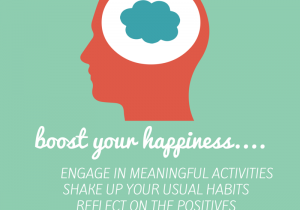
  • Seek out valued activities to become engaged in!  It’s important to remember that the activities we choose must be the right fit for us.  In order for activities and goals to increase our well-being, they have to be meaningful to us!!  Do you value learning?  Then starting a course may bring you increased happiness.
  • Make a habit of your new activity…..but shake it up!!!  We get used to routine, and therefore don’t experience the same happiness from activities we do every day, as we do from new activities….have you taken up running?  Instead of the treadmill, try running on the beach tomorrow, or in the park on Sunday.
  • Do a mental shake up of your current activities.  Take time to reflect on the positives, and what you are grateful for – thinking about the positive in your current day to day routine can help you to reignite feelings of happiness in your existing routine!  Work may be monotonous, but what are you learning or gaining from it at the present time?
References
Lyubomirsky , S., Sheldon, K.M. & Schkade, D. (2005).  Pursuing happiness:  The architecture of sustainable change,Review of General Psychology, 9(2), 111-131.

Change your health behaviour by reflecting on your values

Changing behaviour is not easy.  Often we fall into bad habits such as skipping exercise and eating unhealthy food.
For people at high risk of neglecting their health, often hearing messages about healthy eating and exercise falls on deaf ears, and instead can lead to a fear or avoidance response.  It’s all too easy to think “I’ll start tomorrow,” no matter how often we hear about the benefits of healthy behaviours.

A new study by Falk et al. (2015) showed that focusing on values that are personally important to an individual can help people to then act on health advice which they previously perceived as threatening.

Participants were given typical advice about health behaviour like they would receive from a doctor, and underwent neurological scans.  Prior to receiving advice, half of the participants were lead through a self affirmation exercise where they reflected on what’s important to them, such as work or family.  Those who did the self affirmations showed more behaviour change, in a follow up one month after the initial study.

The authors of the study state:

“Neural responses associated with self-related processing and value in response to an otherwise threatening health communication intervention can be changed using self affiramaton….
These findings suggest that affirmation of core values may exert its effects by allowing at-risk individuals to see the self-reference and value in otherwise-threatening messages.”

So what does this mean for you?  Are you sitting on the fence of change?  Before you seek out information, why don’t you think about your values around the change.  For example – you know exercise is a good thing, but just can’t be bothered….why not think about what matters to you first.  Do you value looking after your family?  Think about how change may make you a better parent/sister/etc.  Would better health impact your value of looking after your family?

Think about your values – they might just help you to achieve some serious goals!!

Set Goals, not Resolutions

It’s the new year which means new year’s resolutions.  How many years have you found yourself setting resolution after resolution to lose weight, make more money, give up junk food etc, only to find that it’s February and you haven’t been to the gym in weeks, and have just eaten a chocolate brownie!!

Why is it that new year’s resolutions don’t work?  Simply put, they are often overly generalised or vague, and don’t have the specificity and planning which is needed to help us succeed.

My advice – set goals (and make them good ones!!).

desk2

Here are some simple principles to put in to play which have been demonstrated to help people achieve their goals.

1)  Goals must be specific!!  Want to lose weight?  How much do you want to lose?  In what time frame do you want to achieve it?  How will you measure it?
Goals that are both specific and difficult lead to the highest performance (Locke, 1996).  Making a goal specific helps us direct our action clearly and makes us more likely to achieve a difficult goal.

2)  We need to be committed to our goals, particularly when they are difficult.  Our commitment to goals comes through our belief that the goal is important (Locke, 1996).  When setting your goals, reflect on how important you feel it is that you achieve it.  Did you set the goal yourself, or are you trying to please someone else?

3)  Self efficacy and our feeling of competence to achieve a goal fosters goal achievement.  Do you feel that you have the skills or abilities to achieve your goal?  If not, what will help you to feel more confident?  Do you need a mentor, or perhaps additional resources like materials or information.  The more empowered you feel, the more likely you are to achieve your goal!

4)  Set implementation intentions.  Implementation intentions are the small situational cues we set in line with our goals, which prompt us to take action.  For example, your goal is to spend one hour each day studying.  Your implementation intentions may include the exact time you plan on studying (6pm each night), where you will do it (the desk in your room, with the TV off), the materials you need to do it (notepad, textbook, highlighters).  Setting implementation intentions has been shown to increase goal attainment on difficult tasks (Gollwitzer, 1999).

5)  Write it down and share it with others!!  You’re much more likely to succeed if you put your goal in writing, and enlist the support of others by sharing it with them!!

I hope this has helped with a touch of motivation to start 2015!!  What are you goals for the new year?

References

Gollwitzer, P.M.  (1999).  Implementation intentions:  Simple effects of simple plans.  American Psychologist, 54(7), 493-503

Locke, E.  (1996).  Motivation through conscious goal setting.  Applied and Preventative Psychology, 5(2), 117-124